
If you’re wondering how to overcome the fear of travelling solo as a woman, I have some bad news: you probably won’t. At least, I haven’t. Not completely. And neither have many of the solo female travellers I’ve interviewed for my Substack series, “Aren’t you afraid?”
The truth is, many of us are afraid. We get lost, make the wrong decision, end up somewhere we didn’t intend to be or find ourselves dealing with a situation we don’t know how to handle. Fear is a perfectly normal part of solo travel.
But it changes with experience. We get better at assessing situations, preparing for the things we can reasonably prepare for and figuring out what to do when things don’t go to plan. We learn how to ask for help, choose accommodation that makes us feel comfortable, deal with unwanted attention and cope with loneliness. And, perhaps most importantly, we discover that we’re far more capable than we gave ourselves credit for.
So perhaps we’re asking the wrong question. Instead of “how do I get over the fear?”, what if we asked: How can I enjoy travelling solo even though I’m afraid?
That’s what this article is about. Whether you’re planning your first solo trip or already travelling alone and feeling anxious, I’ll share practical ways to prepare, feel more comfortable and build your confidence, alongside stories from other solo female travellers who have learnt to live alongside their worries.
Is it normal to feel scared to travel alone?
For most women, the fear isn’t really about travelling alone. It’s about all the things that might happen while we’re doing it:
What if I get attacked?
What if I get lost?
What if I get scammed?
What if I get sick or something goes wrong?
What if I feel lonely?
What will people think of me?
These are all completely normal fears. According to the 2026 Solo Female Travel Trends Survey by female-led travel company Solo Female Travelers, 68% of women who travel solo worry about their personal safety, while 36% worry about something bad happening. Other common concerns include language barriers (47%), getting lost (40%) and dining alone (23%). These concerns have remained fairly consistent year after year.
And, of course, there are genuine dangers. Horrible things have happened to women travelling alone, and we shouldn’t pretend otherwise. But many of the things we fear can happen at home too. You can get lost, be followed, get sick or have someone take advantage of you in your own town.
What changes when you’re travelling is the amount of uncertainty you’re dealing with. You don’t know the streets, the language or the local customs. You might not know who to ask for help or what you’re supposed to do if something goes wrong. When everything is unfamiliar, even a relatively ordinary problem can suddenly feel much more worrying.
Then there’s the internet. We’re constantly exposed to stories about what can go wrong when travelling alone, while the millions of women who have completely uneventful trips rarely make the headlines.
It’s no wonder we’re afraid.
Your first solo trip doesn’t have to be a big adventure
If you’re yet to take your first solo trip, don’t feel pressured into thinking it needs to be three months backpacking across Southeast Asia, just because that’s what everyone else seems to be doing. You can start much smaller.
If the idea of travelling alone makes you nervous, choose somewhere that feels relatively familiar for your first trip. A weekend away just an hour or two from home can be enough. Stay for one night and give yourself permission to keep things simple. Have breakfast by yourself. Visit a museum. Sit in a café and watch the world go by. The point is to simply experience what it feels like to be somewhere new without anyone else to rely on.
Once you’re comfortable with that, you can start adding little challenges. Try going on a walking tour where someone else takes care of the logistics, so you can focus on building your confidence. Ask someone where they’re from or how long they’re staying. Get your guide to give you some local recommendations. Activity-based meet-ups like this are a great way to practise talking to strangers because you already have something in common to talk about.
Then build from there. Next time, you might stay for three nights instead of one. Then a week. You might choose somewhere a little further away or more unfamiliar.
If you want some inspiration, UK-based Becky Jackson started simple with a trip to Edinburgh for her first solo adventure:
“I’d always been curious about solo travel, and the idea of having complete freedom to explore at my own pace really appealed to me. But I wanted to start somewhere that still felt familiar and safe. I spent a few days there on my own, mostly wandering through bookshops, stopping at cafés and soaking up the city’s atmosphere. After that, I met up with my partner, and we drove the NC500 around the Highlands, so it felt like the perfect balance: I got to experience the independence of solo travel while still having moments of connection. It really built my confidence and made me realise how rewarding solo travel can be.”
Read Becky Jackson’s full conversation…
How to prepare for any solo trip
You could do absolutely no preparation whatsoever and embrace the adventure, or you could prepare for every eventuality and research every possible way your solo holiday could go terribly wrong. I suggest aiming for a sweet spot somewhere in the middle.
If you’re travelling abroad, check the current official travel advice for your destination, including safety and security information, local attitudes towards women, entry requirements, local laws and health advice. Make a note of emergency numbers and, if it makes you feel more comfortable, find out where the nearest hospital or police station is.
It’s also worth making sure you have backup access to the information you might need if you lose your phone or internet. Save your accommodation details, directions, passport details, travel insurance information and important contact numbers somewhere you can access them offline. You could also leave copies of important documents with someone you trust back at home and let them know your travel plans.
You don’t need to memorise the entire destination before you arrive. Part of the fun of travelling is figuring things out as you go, and you don’t want to research away every last bit of spontaneity. But removing some of the obvious unknowns can make arriving somewhere new feel much less daunting. I’d also:
- Make a plan for getting from the airport or station to your accommodation. If navigating public transport after a long journey sounds stressful, book a pre-arranged taxi and remove the problem altogether.
- Check whether your phone will work at your destination and what your data options are. You may need a local SIM or eSIM.
- Find out which areas are best avoided at night so you know where you’ll feel comfortable walking around.
- Have a quick look at how the local public transport works.
- Pack a decent power bank.
- Download an offline map of your destination.
And, of course, we don’t want to spend all our preparation time thinking about what could go wrong.
Read travel guides by other solo female travellers, save a few places you’d like to visit and get a feel for the destination you’re heading to.
How to choose the best solo-friendly accommodation
Your accommodation can make a huge difference to how comfortable you feel, particularly when you’re travelling somewhere unfamiliar for the first time.
Hostels can be a great option if you want something social. Many now have female-only dorms or floors, and they’re often a guaranteed way to meet other travellers, make friends and feel less alone in a new place.
But the key is choosing accommodation that makes you feel comfortable, rather than booking what you think you “should” be booking. If dorms aren’t your thing, book a private room in a hostel instead. Or skip the hostel altogether and treat yourself to a hotel. I tend to mix things up depending on where I am and what I fancy, from house-sitting and budget hotels to nice-looking hostels with plenty of amenities.
It’s also worth checking out the neighbourhood before you book. A beautiful hotel won’t be so relaxing if you have to walk through a sketchy area every evening to get back to it.
For your first night somewhere unfamiliar, I particularly like the idea of booking accommodation where there’s definitely going to be someone around to help. Solo traveller Sophie Bellamy does this too:
“I tend to book a hotel with a 24/7 front desk for my first night in a new destination rather than an Airbnb, as that’s easier for a taxi driver to find and I know there will definitely be someone there to greet me.”
Read Sophie Bellamy’s full conversation…
That little bit of certainty can make arriving somewhere new considerably less stressful. You can always change things up once you’ve found your feet.
How to build confidence when travelling solo
One of the easiest ways to build confidence is to stop measuring it by whether you actually felt confident, and instead, start looking at what you actually did.
You might have felt stupid getting on the wrong bus, but you still figured out where you needed to go. You might have felt embarrassed asking for a table for one, but you went out for dinner anyway. You might have been nervous joining a group tour, but you still chose to go out and meet people instead of spending an afternoon alone.
These moments count. So at the end of each day, write down three things you handled yourself. They can be as big or as small as you like. Over time, you’ll have a little record of all the things you’re capable of. And when something unfamiliar happens on your next trip, you have evidence to remind yourself that you’ve figured things out before, and you’ll figure this out too.
You can also set yourself tiny social challenges. For example:
- Ask someone for a recommendation
- Chat to the person standing beside you on a tour
- Ask a local for their favourite place to eat
- Spend 30 minutes walking around a new city without looking at your map
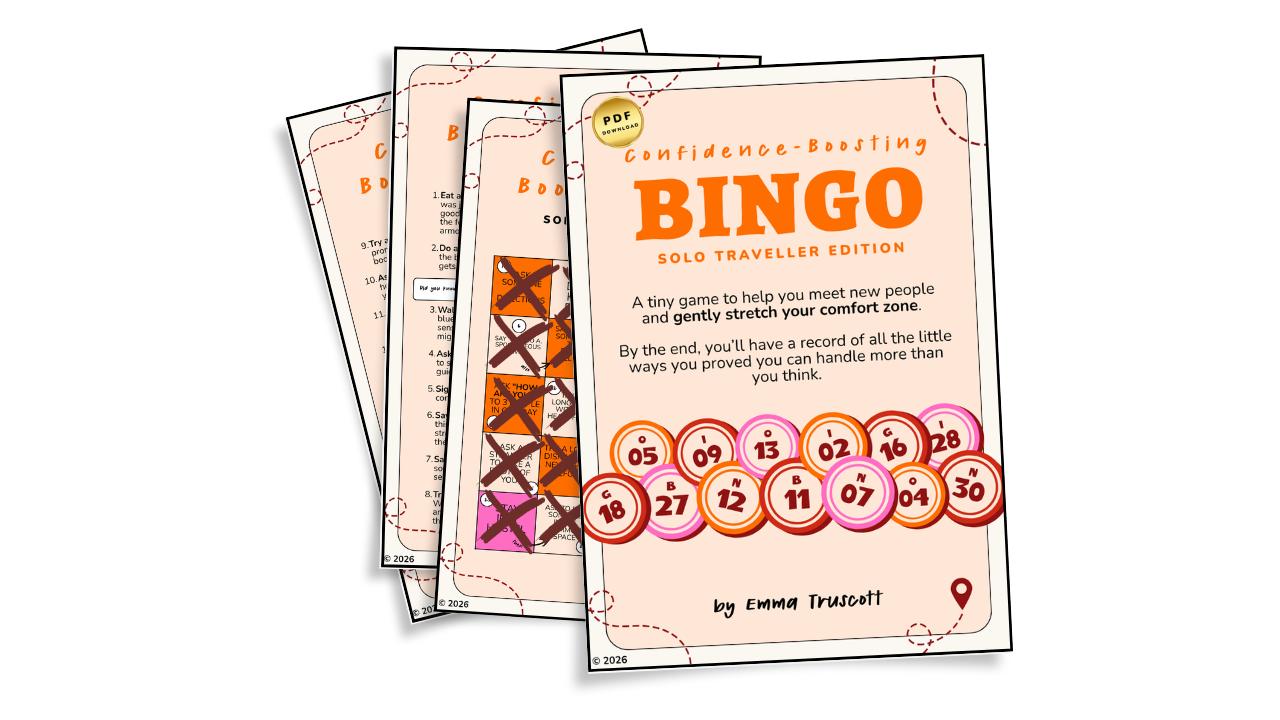
If you want some more ideas, I’ve put together a confidence-boosting bingo with lots of fun, manageable challenges. Give it a try and see how many you can tick off.
How to deal with unwanted attention when you’re travelling solo
Unfortunately, there isn’t one magic solution that guarantees nobody will bother you. If someone’s making you uncomfortable, you don’t owe them your time, attention or politeness. Speak clearly and firmly: “No, thank you.” “I’m meeting someone.” “I need to go.” “Please leave me alone.” Or you can simply walk away.
Body language can help too. Keep your head up, walk with purpose and don’t feel obliged to engage with someone simply because they’ve spoken to you. If something doesn’t feel right, get yourself somewhere public and populated. Walk into a hotel, café, shop or other business and ask for help. And don’t underestimate the power of seeking out another woman. Sometimes, a little creativity helps too. I love solo traveller Emma Schneck’s approach:
“I bring my imaginary husband everywhere. When anyone asks me, ‘Are you travelling alone? Do you have a boyfriend? Where is he?’ I just say something vague like, ‘Oh, I’m with my husband, he’s back at the hotel sick with food poisoning.’ Poor guy, he’s always sick with food poisoning.”
Read Emma Schneck’s full conversation…
I always carry a personal alarm in my bag, although thankfully I’ve never needed to use it. If you choose to carry any safety devices, check the laws in your destination first, as something that’s legal at home may not be legal elsewhere. You could also carry an old wallet with expired cards as a decoy if you’re concerned about theft.
What to do if something goes wrong while travelling solo?
Of course, sometimes things really do go wrong. You get ill, lose your passport, have something stolen or find yourself in a situation you weren’t expecting. Deal with the immediate problem first, then work out what you need to do next.
If you become ill or injured, seek appropriate medical attention and contact your insurer as soon as possible. Keep receipts, medical paperwork and any other documentation your insurer may need. If something is stolen, report it to the local police where appropriate and keep a copy of the report for your insurance claim. If you lose your passport, contact the relevant authorities and your nearest embassy, high commission or consulate.
And… ask for help.
This is one of the biggest themes in the conversations I’ve had for my “Aren’t you afraid?” series with other solo female travellers. Again and again, women have shared stories of kindness where strangers have stepped in to help when they’ve needed it most.
A local woman took Emma Schneck for coffee and cookies when she saw her crying in the street after she’d been told she’d lost her job. Two Dutch men helped Mary McPherson get into a Norwegian cabin after she found herself locked out, lending her their power bank and topping up her water at the same time. Another man helped Khristee Rich cross a busy street in South America. A Japanese woman helped Becky Jackson at a train station when she wasn’t sure where to go.
I could go on. And on.
The world isn’t always as scary as we’re made out to believe. Most people out there are kind and willing to help someone in need.
So, how do you get over the fear of travelling solo as a woman?
I think most solo female travellers will tell you they’ve been followed, scammed, lost, lonely and wondered what on earth they were doing. But if you ask them if they were afraid to travel solo, often the answer will be, “Yes, but I did it anyway” or “Yes, but I’m more afraid of going nowhere” or “Yes, but I’m more afraid of my home country.”
And that doesn’t mean you should ignore your fears or throw caution out of the window. Prepare for the things you reasonably can. Check the travel advice, know how you’re getting to your accommodation, choose somewhere you’ll feel comfortable staying and make whatever other preparations you need to help you feel more confident.
But you don’t have to prepare for every possible disaster. You don’t have to travel in exactly the same way as someone else. And you don’t have to wait until you’re completely fearless.
The goal isn’t to become someone who isn’t afraid. It’s to become someone who knows what she needs to do to feel comfortable, knows how to handle the things she can’t control and trusts herself enough to go anyway.
Want more stories and practical advice from solo female travellers? Subscribe to my Substack series, “Aren’t you afraid?”, where I interview women about their fears, their experiences and how they learned to travel with the fear too.
